

Council of Europe Committee of Ministers Urges Romania to Strengthen Protection Against Sexual Harassment in the Workplace
On 11 March 2026, the Committee of Ministers of the Council of Europe adopted a decision urging Romania to take further measures to ensure effective protection against sexual harassment in the workplace and to properly implement the judgment of the European Court of Human Rights in C. v. Romania.
The Committee expressed concern about the authorities’ response to sexual harassment complaints and called on Romania to strengthen institutional capacity to prevent, investigate, and sanction such conduct. In its judgment, the European Court of Human Rights found that the Romanian authorities had failed to respond adequately to the applicant’s complaint of sexual harassment at work, in violation of the state’s obligations to ensure effective protection from gender-based violence and discrimination.
In its latest decision, the Committee called on the authorities to put in place targeted training and awareness-raising measures for police officers, prosecutors and judges on the offence of sexual harassment in the workplace. It also invited the authorities to cooperate closely with civil society organisations, the Ombudsperson and relevant expert bodies of the Council of Europe, and to provide the Committee with data on the prosecution and punishment of workplace sexual harassment offences.
Despite the legal framework in place, survivors of workplace sexual harassment in Romania continue to face significant barriers when seeking accountability, including ineffective investigations, lack of specialised training among authorities, and persistent stigma surrounding sexual harassment.
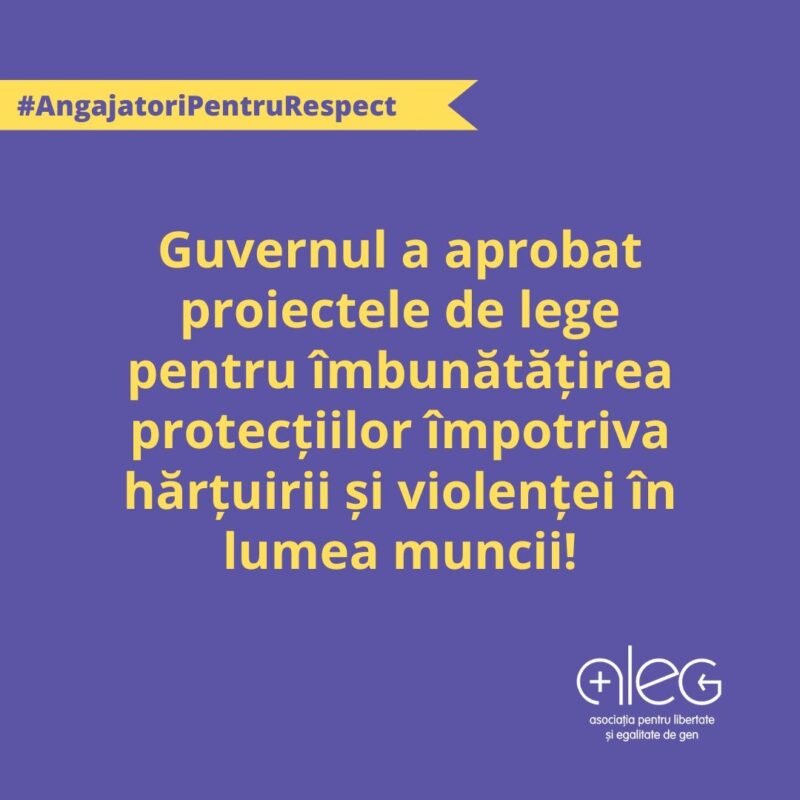
The Committee also welcomed a government-approved legislative package currently pending in Parliament aimed at preventing, combating and sanctioning harassment in the workplace and invited Romania to keep it informed about parliamentary progress, inter-institutional coordination and the involvement of civil society in the legislative process, in order to ensure that the new framework is implemented effectively in practice.
“ALEG welcomes the Committee of Ministers’ continued supervision and its recognition that stronger measures are needed to address sexual harassment in the workplace,” said Camelia Proca, A.L.E.G.’s Executive Director. “Meaningful reform must include adequate laws and effective implementation, proper training of authorities, and collaboration with civil society organisations that support survivors. The adoption of these measures is part of the objectives we are pursuing through the Employers for Respect campaign, through which we are calling on the state to align its laws, public policies, and institutional practices with the standards of International Labor Organisation Convention No. 190 on Violence and Harassment.”
The Committee will continue to supervise Romania’s progress in ensuring effective protection against sexual harassment and gender-based violence in the workplace.
Note to editors:
In C. v. Romania, the European Court of Human Rights found that the authorities failed to conduct an effective investigation into the applicant’s complaint of sexual harassment in the workplace.
The Committee of Ministers of the Council of Europe supervises the implementation of judgments of the European Court of Human Rights. As part of this process, civil society organisations may submit information regarding states’ compliance with the Court’s rulings.
A.L.E.G. submitted a communication to the Committee of Ministers highlighting persistent shortcomings in Romania’s response to workplace sexual harassment and calling for comprehensive measures to ensure effective prevention, investigation and accountability.
The “Employers for Respect” campaign, initiated and coordinated by A.L.E.G. The gaps in the legal framework regarding harassment in the workplace and the poor implementation of the law are documented in this policy brief published by A.L.E.G. in 2021 and in the policy brief on the harassment of migrant workers, published by A.L.E.G. in 2023.